My most humbling realization since moving to an acre in the Sonoran Desert

One of the things that drew me to the property I bought in July was the neighborhood’s tendency to invite the desert in rather than pave it away.
When I noticed a White-winged Dove peering down at me from a nest on the back porch eave, I realized the house already had tenants.
I’ve now watched roughly half a dozen dove families raise their young at my home, which we’ve jokingly dubbed “The Dove Factory” because so many new models come off the assembly line.
There’s nothing I love more than witnessing shift change, when mom and dad take turns sitting on the nest and feeding their young something called crop milk, which sounds really gross but helps these birds go from helpless, pink, featherless blobs to full-grown birds in a matter of weeks.
But as much as they feel like part of my family, no matter how many times the nesting doves have seen me, they never seem to work out that I mean them no harm.
They always hit me with that empty, frozen, non-blinking expression as if to say, “Please don’t see me sitting here.”
Doves and pigeons are notoriously bad nest builders. I mean, there’s an entire section on Reddit dedicated to stupid dove nests. But the one on my back porch is a masterpiece, built over many years by generations of doves, each adding a few sticks to make it theirs.
It’s roomy, sturdy, and sheltered from the elements. By dove standards, it’s practically a gated community.
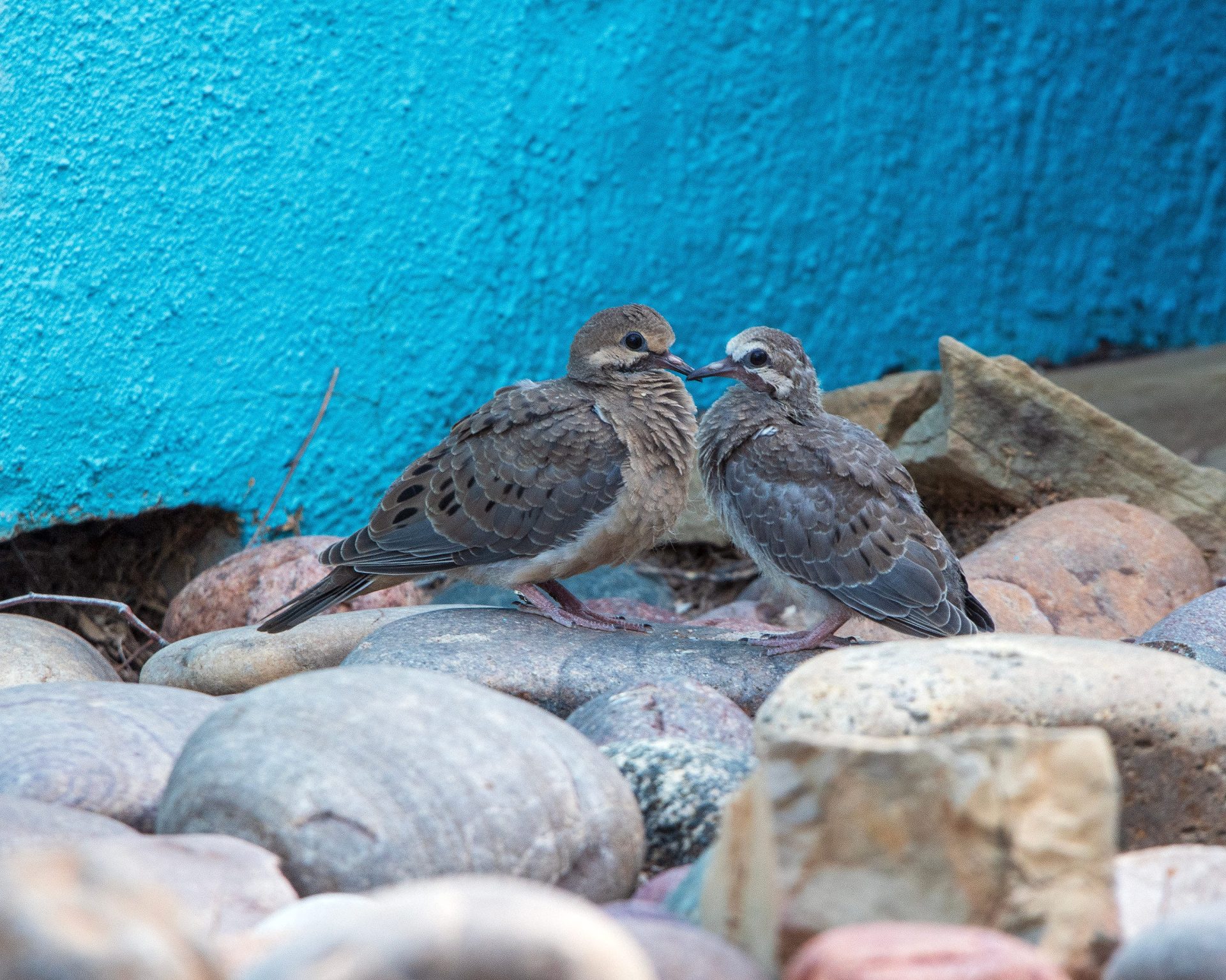
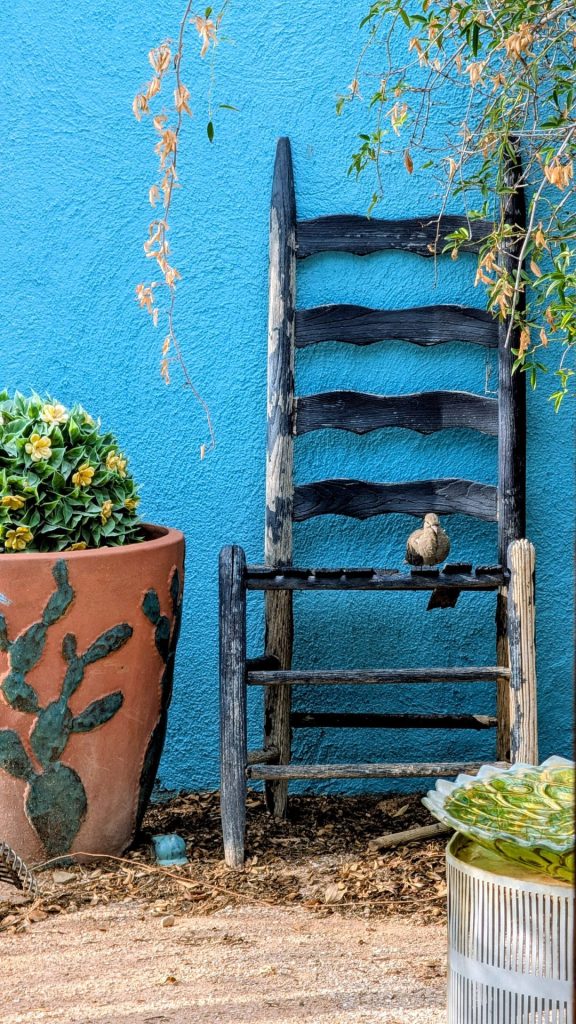
And for birds that many see as dim-witted, using my front and back porches to raise young is straight genius. The thick stucco walls and bougainvillea bushes make a perfect crib and nursery for the chicks in the days after they fledge, when the parents continue caring for them from the ground.
And more often than not, my dove families raise two squabs from eggs to young adults who fly away.
But nature is metal, and sometimes no amount of precaution on the parents’ part or intervention on mine makes a difference.
Like the time I walked outside on a 100+ degree day and found a nestling wriggling on the hot concrete. I ran for my step stool and a piece of cardboard, unable to live with the thought of leaving the poor thing to its fate.
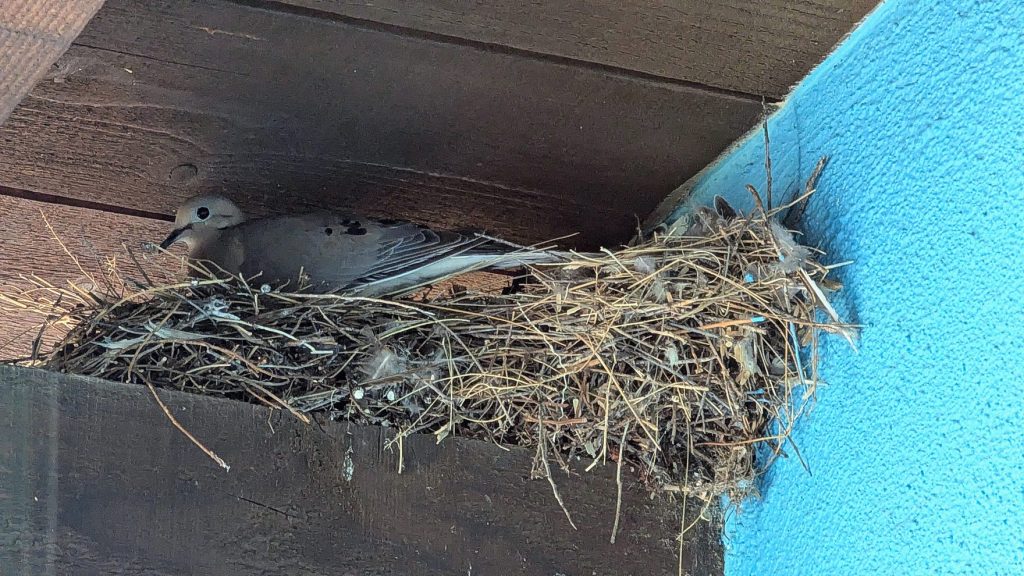
I gently deposited it back into the cavernous nest, much to the displeasure of its parent, who swatted at me pathetically with one wing, unable to see that I was trying to help or understand my profuse apologies in English. (Still working on my Dovese.)
My rescue efforts hadn’t made much difference, though, because a few days later I found the baby on the ground again, this time expired.
The first owner of my home, a spiritual teacher, left a shrine of sorts under a mesquite tree for her beloved basset hounds. I walked the squab back there and laid it among the urns, shells, and quartz crystals, feeling it was a better resting place than the concrete of my back patio.
I watched its sibling grow up and fledge. These doves were half successful.
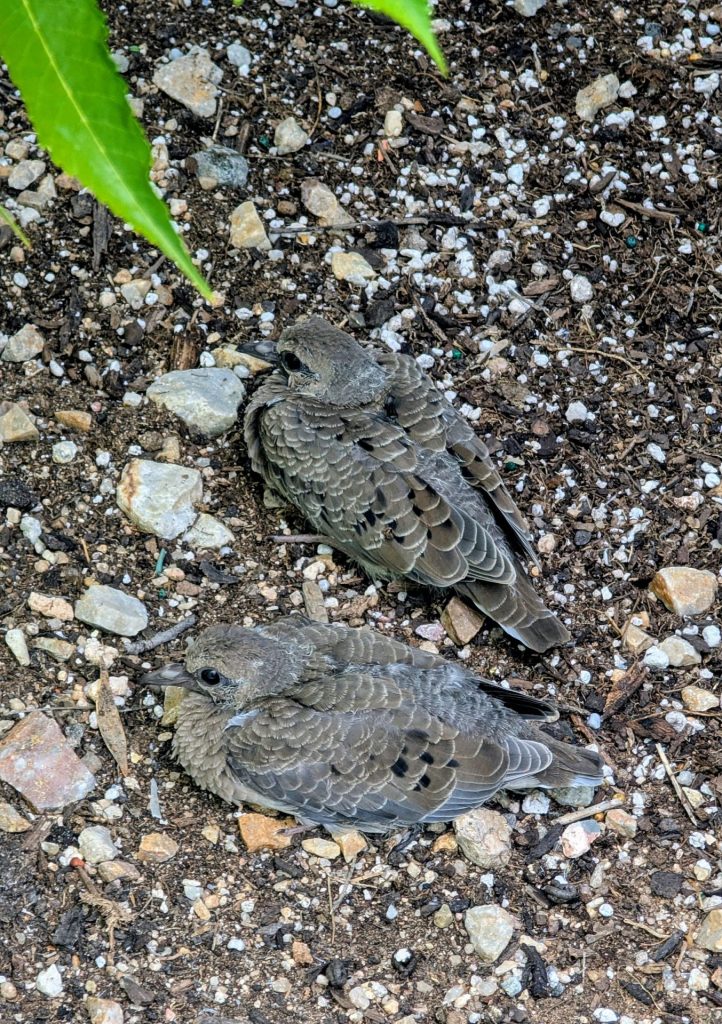
And physics isn’t the only calamity working against us. Predators lurk, probably looking to feed their own young.
But somehow that doesn’t make it easier to accept when I watch a hawk snatch an adult dove as it returns to its nest, or find a fledgling missing after my security camera catches a bobcat prowling around the porch. (I can’t prove the bobcat was responsible, but the circumstantial evidence isn’t doing it any favors.)
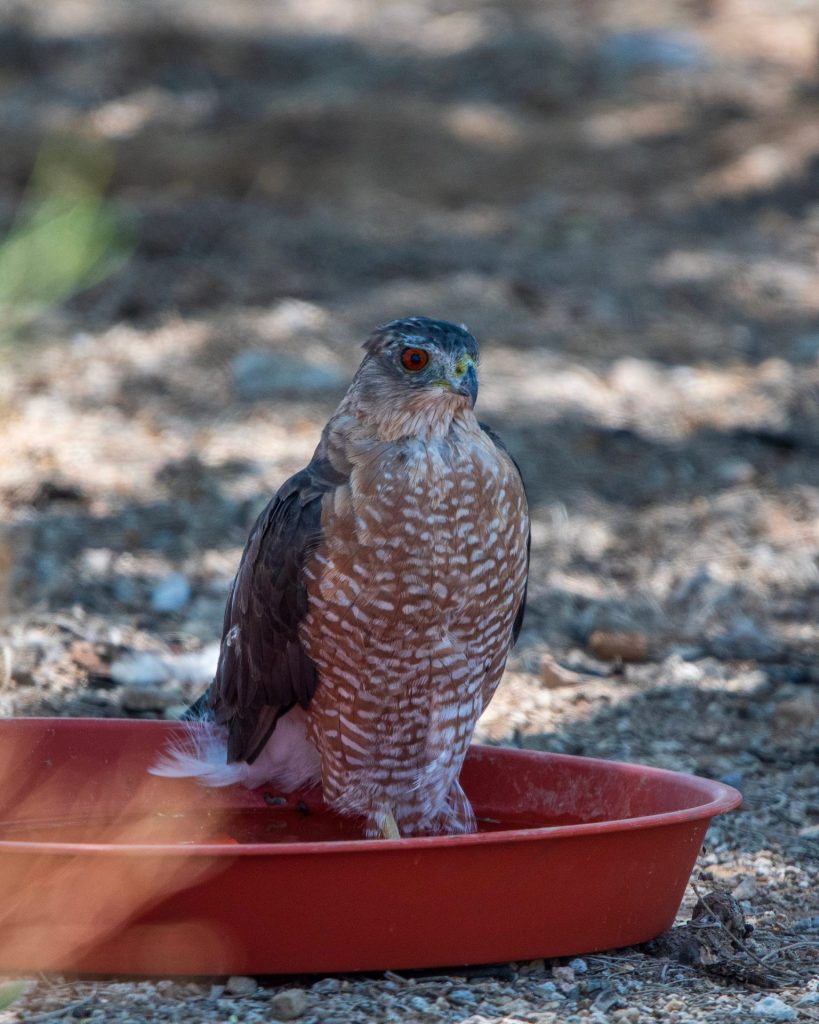
Sometimes my sense of justice gets the better of me, and I move to defend the defenseless before logic takes hold, like the time I watched from my kitchen in horror, coffee cup in hand, as a Cooper’s Hawk flew under my patio to grab a young bird out of a nest. I yelled NO and opened the back door, startling the hawk and causing it to miss a meal.
I warred with myself for days afterward. I’d saved the dove, but I’d also deprived the hawk. And for all I knew, it had hungry chicks of its own waiting somewhere. My intervention hadn’t necessarily prevented suffering. It might have just shifted it to another animal.
Had I done the right thing, or was it wrong to let my emotions and human tendency to anthropomorphize take over?
There’s always a card-carrying member of the Internet peanut gallery rushing to my comments section to tell me they would’ve saved the birds. As if I hadn’t already spent days agonizing over when to intervene and when to leave well enough alone.
It’s easy to take the moral high ground when you’re safely behind a keyboard, spared the discomfort of making a decision that you know will leave a dent in your psyche. You get to feel like the hero while avoiding any emotional heavy lifting.
But what happens when sparing one wild animal means another may perish?
The hardest thing I’ve learned living on an acre in the Sonoran Desert is that caring about the creatures I share my home with doesn’t mean I can or should protect them from everything. Sometimes the best course of action is no action at all, even when every instinct I have screams otherwise.
Now, if you’ll excuse me, it’s time to clock in for my next shift as supervisor of The Dove Factory.